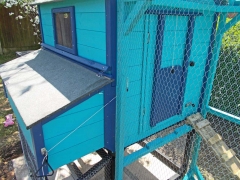
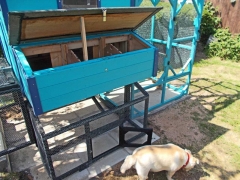
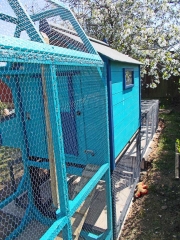
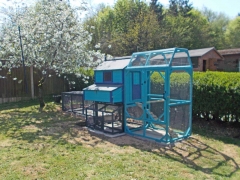
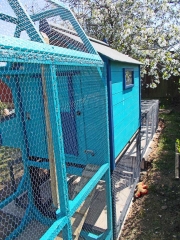
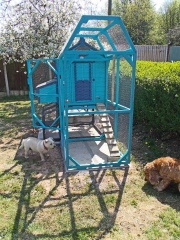
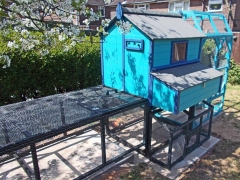
So yesterday was chicken day and it was a busy day for me. I was up and about quite early and set up the rear of my vehicle with three cages for transportation, well actually it was a cat carrier, a puppy carrier and a pet cage. The idea was a 1,3, & 4 arrangement for transporting the birds which actually worked out quite well, plus a couple of dark covers to keep them calm. I had made a small spring loaded wicket gate that could be used to isolate the main run by pulling on a cord and tying it off to keep it closed, otherwise it would gently spring back into the fully open position so I had to fit this prior to collecting the chickens.
The place we visited was a pleasant 30 minute drive into the open countryside and easy to find and another couple were also there buying some chickens. We were all greeted on arrival and in a very informal manner were given an interesting talk by the lady on general feeding, hygiene, vaccinations etc. plus a printed crib sheet, all very handy if you were new to the game. It was all very relaxed and we crated up our chosen birds with the husband expertly grabbing the chosen chicken from the various pens and asking for approval or maybe suggesting another bird that may be a better choice before handing them over. He happily gave my daughter a lesson on wing clipping and allowed her to do one for herself under his supervision which was good as it gave her confidence in handling them.
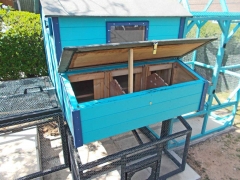
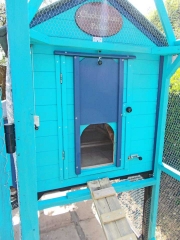
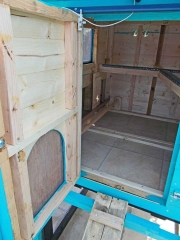
On our return I placed each one into the coop while my daughter operated the sliding door. This gave me a chance to see how each bird reacted to being handled and it was pretty much as I expected with some being very calm and unconcerned while others squawked their heads off. We sat on the lawn with a cup of tea to wait about half an hour before releasing them and looking in the side windows they were all mingling together quit happily, some exploring nest boxes and others on the perches. The amusing part was when I allowed them out, we must have sat there for three hours watching the coop, but never had a full compliment come out at the same time, it was three out two go back, five out three go back in again, my daughter was getting really frustrated by the lack of chickens in the run.

After about 7pm I left for home after telling her that they would almost certainly come out for a feed prior to going to roost and to close the door at dusk once they were all in the coop. I had to laugh because as I arrived home my daughter text me to to say “they are all out now”. So I did not get any pictures yesterday and instead have used some stock images to show the varieties we bought yesterday. In keeping with my daughters nature they all have a name.

We had 8 chickens in total comprising of 7 different varieties, they are as follows:
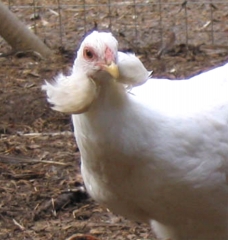
Two Araucanas, a bird that originated in Chile and they lay blue eggs (about 85% chance). They look a bit unusual with tufted ear feathers and no real tail or rump and are mainly white with the odd bluish splash on the body feathers. Names = Molly & Polly
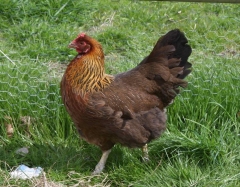
One Welsommer, this breed originate in Holland and in my opinion are a lovely bird, the cockerels are stunning to see. The hens are not so flamboyant but still look very nice, the one we have is a good example and was the most expensive bird we bought. Name = Nelly
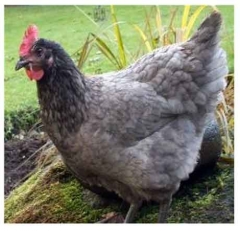
One Blue Ranger (or Bluebell) These are a hybrid cross between a Rhode Island & a Maran chicken. They are a very well feathered bird with a lovely bluish/lavender colour. Name = Rosemary.
One Speckledy, this is another Rhode Island & Maran cross hybrid with the speckling of the Morans feathers being more dominant. Name = Parsley
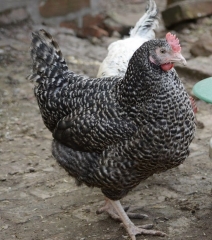
One Silver Sussex, the Sussex breed is reckoned to be one of the oldest and was maybe introduced by the Romans. There are quite a few variations on the Sussex breed and they range through white to red, the Silver is quite a dark bird with silvery neck feathers. Name = Sage
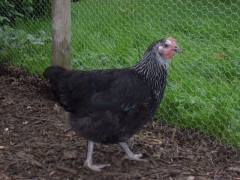
One Rhode/Rock, these are a very dark feathered bird with a golden coloured neck and bluish/black iridescent feathers on the back. Name = Thyme
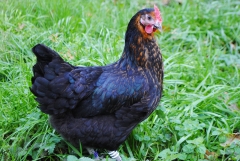
One Calder Ranger, a fairly common chicken, light brown in colour and a good egg layer that is very often kept in large flocks. Name = Sally
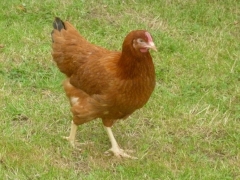
Apart from the ones that lay blue eggs all the others should lay different variations of brown eggs from light brown to very dark brown with speckles in the case of the Welsommer. Apart from the Welsommer which is 28 weeks old all the rest are 18 weeks old and are what is described as ‘Point of Lay’ which as the name implies they are ready to start laying very soon. I think that once it is settled in the Welsommer will be laying eggs as it is showing all the right signs in wattle and ear lobe size and colour. A couple of the others like the Silver Sussex are coming close to laying, but the others will be about 4 weeks away IMO and some a little longer.
I will try to get some pictures later if they are out and about in the run.

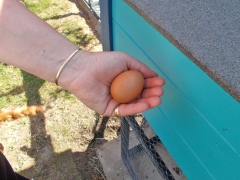
I am awaiting the first frantic phone call to say “I’ve got an egg! I’ve got an egg!” she will probably get so excited she will drop it.


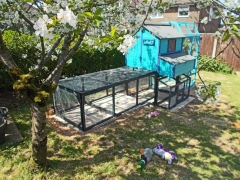
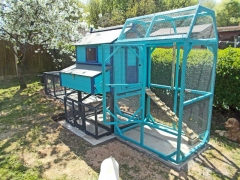
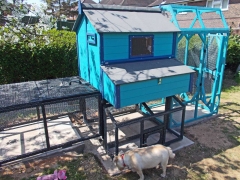
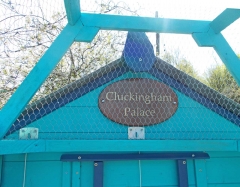



 Top notch job well done!!!