Corfe Castle is like many around our island a ruin, it is now under the control of ‘The National Trust’ who specialise in maintaining these sites around the country. The main castle entrance is in the pretty little town of Corfe, but parking there is difficult, fortunately there is a very large pay & display car park out of the town and from that point a very pleasant walk takes you around the castle boundary and an inclined path eventually raises you to the level of the castle entrance. The castle proper is constructed on a prominent mound that looks like it has some human input although it may all be a natural prominence.
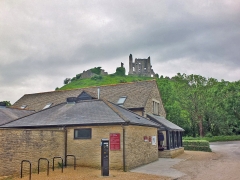
The car park with view of the castle
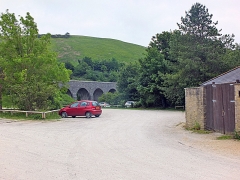
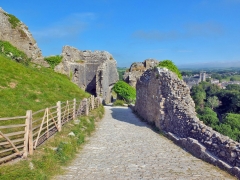
The walk up to the entrance
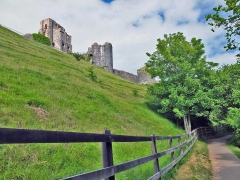
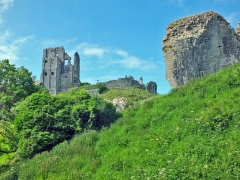
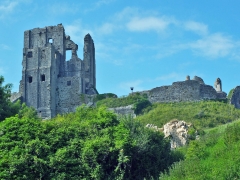
Note the entrance bridge and the collapsing walls and towers
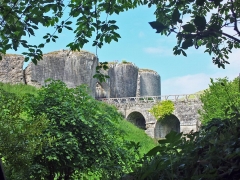
This particular feature on the castle wall is the outside Loo
 It's correct name is a 'Garderobe' (Sp) it is French for 'Bog'
  and would have dumped the Poo straight into the outer area of the castle surrounds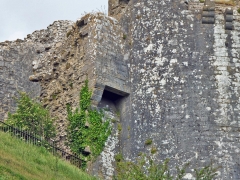
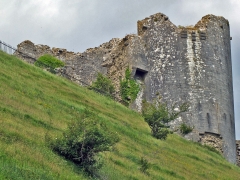
After paying your admittance you cross into the castle grounds which at one time had a large ‘curtain’ wall surrounding the entire area, these must have been very impressive when the castle was in regular use, although nowadays much of the walls have collapsed as a result of age, but also as a result of being blown up during the ‘English Civil War’ when the castle was under attack by Parliamentary forces.
The entrance
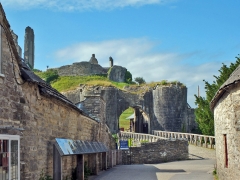
Inside the grounds
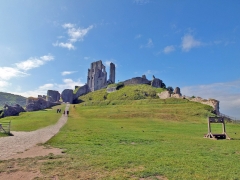
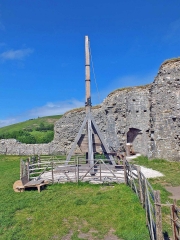
Inside the castle there are a few artifacts such a as a working 'Trebauche' (Sp) used to hurl rocks during sieges.
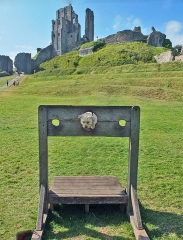
And these stocks used to punish vandals and hooligans as shown here
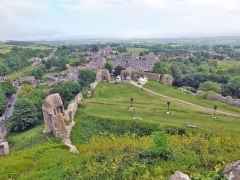
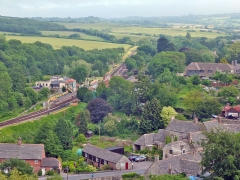
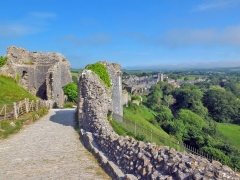
It is quite a steep but steady climb upwards from the entrance to the actual castle buildings which must have been very impressive although much is now in ruin. From the top you have some spectacular views around the countryside and a very good one of the town below and of the railway station.
The town of Corfe and the railway station
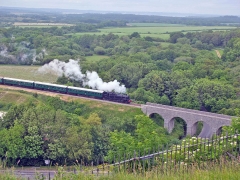
You also get some good sightings of the steam locomotive crossing the bridge on its way from Norden towards Swanage, for anyone able bodied it is well worth the climb to the top.
The train to Swanage
As you can appreciate it is difficult to describe a castle ruin and what you did there, so I will give you a brief history of the castle and then let the photographs tell their own story.
There has been some sort of fortification on this site for over a thousand years, in 976 AD it is thought that ‘King Edward the Martyr’ was murdered by his stepmother ‘Elfrida’ at the site of the Old Hall.
In 1086 AD a few years after the Battle of Hastings (1066) ‘William the Conqueror’ swapped a church in Gillingham for the land on which he started to build Corfe Castle.
In 1106 AD King Henry 1st fought a battle against his older brother ‘Robert of Normandy’ and after he beat him in battle he locked him up in the castle keep.
In 1138 during the reign of King Steven, his cousin ‘The Empress Matilda’
attempted to claim the throne by raising an army against him, the castle which was in the hands of one of her supporters ‘Baldwin de Redvers’ was attacked by King Steven. Anyone who is familiar with the TV series ‘Cadfael’ which starred Derek Jacobi will recall that the series was set within this historic period when King Steven & the Empress Matilda were feuding over the crown of England.
In 1199 AD to 1214 AD King John imprisoned his French niece ‘Princess Eleanor of Brittany’ and many of her knights in the castle, she survived but many of her knights did not and about 22 of them died there.
1220 AD to 1294 AD was a fairly peaceful time and subsequent Kings such as Henry 3rd and Edward 1st carried out much building work to improve the castle and modernise the defences of the castle.
1572 AD the last royal owner of the castle Queen Elisabeth 1st sold Corfe to one of her court favourites ‘ Sir Christopher Hatton’.
In 1635 the castle was sold to the Lord Chief Justice ‘Sir John Bankes’ who’s family stayed true supporters of King Charles during the English Civil War, even though all of the surrounding land in the county of Dorset was under the control of Parliamentary forces.
1643 to 1646 under the control of a woman who became known as ‘Brave Dame Mary Bankes’ the castle held off two sieges during the English Civil War. It was finally captured due to treachery from within the castle itself,
1646 to 1663 the castle was looted and partially demolished by order of Parliament and Lady Bankes’s son ‘Ralph’ tried to recover what was left, but he gave up and later build a mansion near to Kingston Lacy.
In 1982 after being in the Bankes’s family for over 350 years it was finally handed over to The National Trust for preservation for the nation.
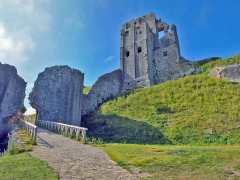
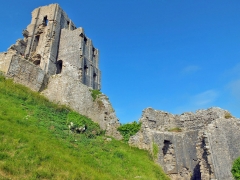
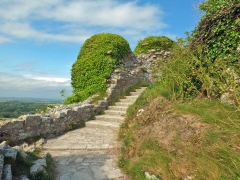
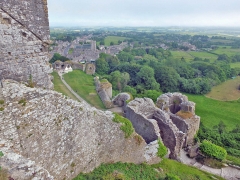
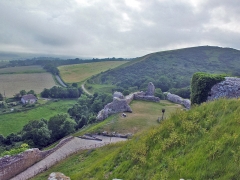
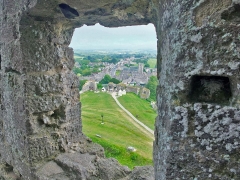
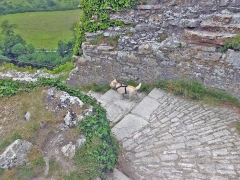
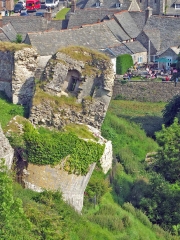
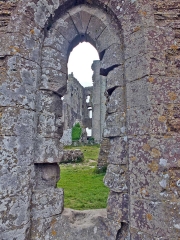
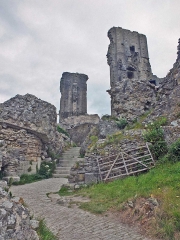
Various Views



 ) I note that you have the camera set to 4:3 ratio. My pictures along the river (also 4:3) made me ask myself if 16:9 would not be a better format as all computers and TV's use that ratio. Any views???


 but she is quite good when out and about and is very well behaved in the car and travels really well.