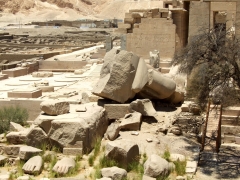
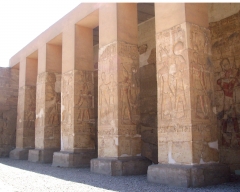
Todays pictures are from the Ramesseum located on Luxor’s West Bank and are of the fallen statue of Ramesses the II, better known as ‘Ramesses the Great’
This is usually cited as being the inspiration for the sonnet ‘Ozymandias’ by Percy Bysshe Shelley 1792 – 1822. Although it may not actually be this particular statue as there are a few discrepancies if you compare it with the poem.
It was by the way his second wife Mary Shelley who wrote the famous Gothic novel, Frankenstein.
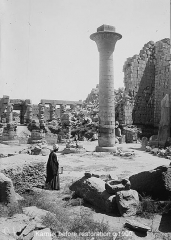
The fallen statue of Ramesses II (Ozymandias in Greek) taken around 1900
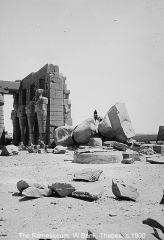
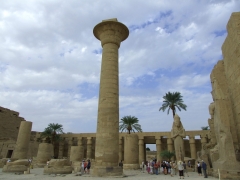
A recent picture
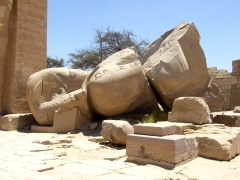 The poem
I met a traveller from an antique land
The poem
I met a traveller from an antique land
Who said: "Two vast and trunkless legs of stone
Stand in the desert. Near them on the sand,
Half sunk, a shattered visage lies, whose frown
And wrinkled lip and sneer of cold command
Tell that its sculptor well those passions read
Which yet survive, stamped on these lifeless things,
The hand that mocked them and the heart that fed.
And on the pedestal these words appear:
`My name is Ozymandias, King of Kings:
Look on my works, ye mighty, and despair!'
Nothing beside remains. Round the decay
Of that colossal wreck, boundless and bare,
The lone and level sands stretch far away".
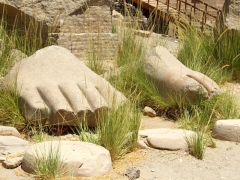
Here are the famous feet, hardly "vast and trunkless legs" as described in the poem, but they are very big!
There has been some speculation of late that they may restore the statue to its upright position. I am not really sure if I am in favour of this or not, part of me says leave it as it has been for a millennium, but the other parts says wow, imagine seeing it together again, all 1,000 tones of Aswan granite. Most of the bits are still there including the part with the hands on, most are hidden in the vegetation and general rubble in front of the statue. It can be best seen if viewed from the top of the pylon and looking down on the feet you can see how the seated figure has toppled backwards during an ancient earthquake.
Looking down from the pylon onto the plinth and feet.