Ightam Mote - A Medieval Gem
Posted: Thu Aug 20, 2015 5:17 pm
Ightham Mote:
This is one of my favourite National Trust properties. I should have taken a dictaphone to record all the facts about the house that the volunteers in each room are happy to tell, so most of the accompanying text has been 'borrowed' from Wiki and as far as possible I have linked the text with appropriate photographs. A lot of pictures, I took far more, but I think the house deserves a full account. I hope you find this of interest.
The original house was built around 1350 and I love the fact that, with additions and modifications it became a medieval courtyard manor house with a moat, and has remained with very little alteration since the courtyard was completely enclosed. Many such properties had at least one side removed to open up the house to its estate but Ightam Mote remains a totally enclosed quadrangle still with its defensive moat and tower. It has been observed that "Ightham wholly surrounds its courtyard and looks inward, into it, offering little information externally". This is very true. The outer walls are plain and sheer dropping straight down into the moat whereas in the quadrangle there are windows looking into the courtyard and one can imagine the family relaxing and playing games in that protected area.
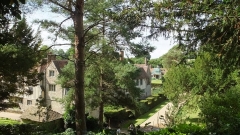
This is the approach to the house down a steep path.
The moat of Ightham Mote
There are over seventy rooms in the house, all arranged around a central courtyard. The house is surrounded on all sides by a square moat, crossed by three bridges.
Here are pictures of the four external sides of the house, South, East, North, and the main gate on the West.
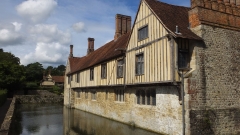
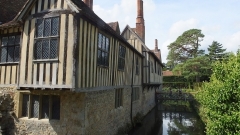
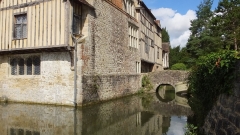

The earliest surviving evidence is for a house of the early 14th century, with the Great Hall, to which were attached, at the high, or dais end, the Chapel, Crypt and two Solars.
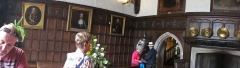
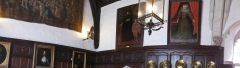
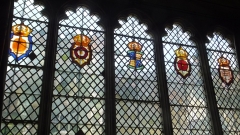
Visitors in The Great Hall (well this is a manor house, not a stately home so the Great Hall is more of a large room). The stained glass coats of arms were added to the window when Henry VIII visited with his entourage.
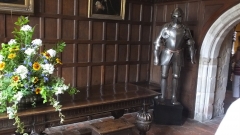
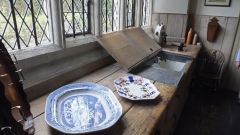
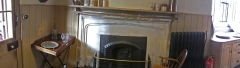
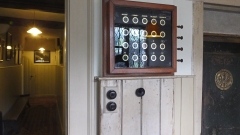
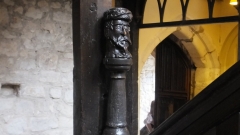
Various pictures around the interior including The chains to wind the clock, A magnificent staircase, The paneled long passage, A room clad in hand painted Chinese 18th century wall paper, 2 pictures of the butlers pantry, servant calls including an old voice tube, A superb newel post and another of the three staircases.





The old chapel. Holes in the wall were for scaffolding during construction. In the oak plates supporting the roof trusses can be seen cut outs that supported the timbers for the second floor which has a fireplace high up the wall and was the two 'solars', sitting rooms, at the time of construction but the floor was unsafe and removed. The other picture is the Crypt.

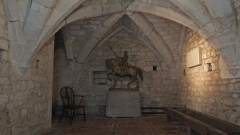
And the 'New Chapel' quite old really, can't remember the date.


The courtyard was completely enclosed by increments on its restricted moated site and the battlemented tower constructed in the 15th century. Very little of the 14th century survives on the exterior behind rebuilding and refacing of the 15th and 16th centuries.
Pictures in the courtyard
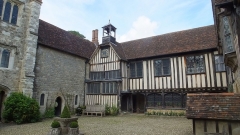
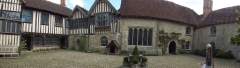
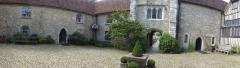
Views from the tower. Admission to the tower is timed and limited to 15 people. The circular stairs are of oak and easily ascended.


During extensive work on the fabric of the building, many artefacts were found and here are some of them. It was common practice for a craftsman to place one of his old shoes into the structure, usually above a lintel, to bring good luck to the house. Here are just some of what was found.



The courtyard gatehouse
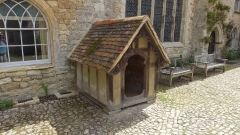
The structures include unusual and distinctive elements, such as the porter's squint, a narrow slit in the wall designed to enable a gatekeeper to examine a visitor's credentials before opening the gate. An open loccia with a fifteenth-century gallery above, connects the main accommodations with the gatehouse range. A large kennel built in the late 19th century for a St. Bernard named Dido is the only Grade I listed dog house.
The gatekeepers squint can be seen to the left of the outer gate and a small squint exists on the inner door. The huge doghouse is popular for children to have their picture taken inside.

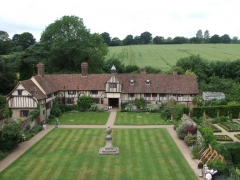
Originally the house had three lakes which fed the moat and then drained to the river Medway 8 miles away. The Victorians liked their lawns and filled the central lake putting conduits beneath to carry the water to the moat. There is a large stable block, now converted into cottages, which housed 60 horses in its day.
Here is a picture of the stables and the steps leading to the upper floor.

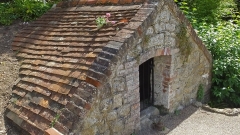
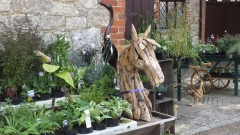
And finally, a small building that I assume was the Ice House, and something in the plant shop especially for Jay.
Finding of skeleton
A rumour is circulated that during the 19th century a female skeleton was found walled up behind a blocked service door. There are no records of a skeleton being found and the rumour has not been entered into the 2004 tour booklet for the houise.
The Selbys
The house remained in the Selby family for nearly 300 years until the mid-19th Century when the line faltered with Elizabeth Selby, the widow of a Thomas who disinherited his only son. The house passed to a cousin, Prideaux John Selby, a distinguished naturalist, sportsman and scientist. On his death in 1867, he left Ightham to a daughter Mrs Lewis Marianne Bigge. Her second husband, Robert Luard, changed his name to Luard-Selby. She died in 1889 and the executors of her son Charles Selby-Bigge, a Shropshire land agent, put the house up for sale in July 1889.
The Colyer-Fergussons
The Mote was purchased by Thomas Colyer-Fergusson. He brought up his six children at the Mote. In 1890-1891, he carried out much repair and restoration, which allowed the survival of the house after centuries of neglect. He converted a lumber room into a billiard room, added bathrooms and central heating, reorganised the kitchen and dining areas and carried out countless repairs. Ightham Mote was opened to the public one afternoon a week in the early 20th century.
Sir Thomas Colyer-Fergusson's third son, Riversdale, died aged 21 in 1917 in the Third Battle of Ypres, and won a posthumous Victoria Cross. A wooden cross in the New Chapel is in his memory, I forgot to look for this cross. A second son Max was killed, aged 49, in an air raid in WWII. During the Second World War, the reduced staff slept in the crypt to shelter from air-raids, and a German pilot was held there for a single night after parachuting onto the estate from his stricken plane.
On Sir Thomas's death in 1951, the property and the baronetcy passed to Max's son James, a lifelong bachelor. The upkeep and repair of the house left him in no option but to sell the house and auction most of the contents. The sale took place in October 1951 and lasted three days. It was suggested that the house be demolished to harvest the lead on the roofs, or be divided into flats. Three local men banded together to save the house purely for love of it: William Durling, John Goodwin and John Baldock. They paid £5,500 for the freehold, what an amazingly cheap price, confident that some other, richer, benefactor would emerge.
Charles Henry Robinson
In 1953, the house was purchased by Charles Henry Robinson, of Portland, Maine, a bachelor. He could stay for only fourteen weeks a year for tax reasons. He made many urgent repairs, and partly refurnished it with 17th-century English pieces.
Some of Charles Robinsons Private apartment within the house. He mistook the eagle over the mirror to be the bald eagle of the USA, it is actually the eagle of The the house of the Habsburgs, Whoops.




In 1965, he announced that he would give Ightham Mote and its contents to the National Trust. He died in 1985 and his ashes were immured just outside the crypt. The National Trust took possession in that year.
National Trust Restoration
In 1989, the National Trust began an ambitious conservation project that involved dismantling much of the building and recording its construction methods before rebuilding it. The project ended in 2004 after uncovering numerous examples of structural and ornamental features which had been covered up by later additions. It is estimated to have cost in excess of £10million.
Thanks to Charles Robinson and The National Trust we have yet another fantastic piece of our heritage for us all to enjoy.
THE END
This is one of my favourite National Trust properties. I should have taken a dictaphone to record all the facts about the house that the volunteers in each room are happy to tell, so most of the accompanying text has been 'borrowed' from Wiki and as far as possible I have linked the text with appropriate photographs. A lot of pictures, I took far more, but I think the house deserves a full account. I hope you find this of interest.
The original house was built around 1350 and I love the fact that, with additions and modifications it became a medieval courtyard manor house with a moat, and has remained with very little alteration since the courtyard was completely enclosed. Many such properties had at least one side removed to open up the house to its estate but Ightam Mote remains a totally enclosed quadrangle still with its defensive moat and tower. It has been observed that "Ightham wholly surrounds its courtyard and looks inward, into it, offering little information externally". This is very true. The outer walls are plain and sheer dropping straight down into the moat whereas in the quadrangle there are windows looking into the courtyard and one can imagine the family relaxing and playing games in that protected area.
This is the approach to the house down a steep path.
The moat of Ightham Mote
There are over seventy rooms in the house, all arranged around a central courtyard. The house is surrounded on all sides by a square moat, crossed by three bridges.
Here are pictures of the four external sides of the house, South, East, North, and the main gate on the West.
The earliest surviving evidence is for a house of the early 14th century, with the Great Hall, to which were attached, at the high, or dais end, the Chapel, Crypt and two Solars.
Visitors in The Great Hall (well this is a manor house, not a stately home so the Great Hall is more of a large room). The stained glass coats of arms were added to the window when Henry VIII visited with his entourage.
Various pictures around the interior including The chains to wind the clock, A magnificent staircase, The paneled long passage, A room clad in hand painted Chinese 18th century wall paper, 2 pictures of the butlers pantry, servant calls including an old voice tube, A superb newel post and another of the three staircases.
The old chapel. Holes in the wall were for scaffolding during construction. In the oak plates supporting the roof trusses can be seen cut outs that supported the timbers for the second floor which has a fireplace high up the wall and was the two 'solars', sitting rooms, at the time of construction but the floor was unsafe and removed. The other picture is the Crypt.
And the 'New Chapel' quite old really, can't remember the date.
The courtyard was completely enclosed by increments on its restricted moated site and the battlemented tower constructed in the 15th century. Very little of the 14th century survives on the exterior behind rebuilding and refacing of the 15th and 16th centuries.
Pictures in the courtyard
Views from the tower. Admission to the tower is timed and limited to 15 people. The circular stairs are of oak and easily ascended.
During extensive work on the fabric of the building, many artefacts were found and here are some of them. It was common practice for a craftsman to place one of his old shoes into the structure, usually above a lintel, to bring good luck to the house. Here are just some of what was found.
The courtyard gatehouse
The structures include unusual and distinctive elements, such as the porter's squint, a narrow slit in the wall designed to enable a gatekeeper to examine a visitor's credentials before opening the gate. An open loccia with a fifteenth-century gallery above, connects the main accommodations with the gatehouse range. A large kennel built in the late 19th century for a St. Bernard named Dido is the only Grade I listed dog house.
The gatekeepers squint can be seen to the left of the outer gate and a small squint exists on the inner door. The huge doghouse is popular for children to have their picture taken inside.
Originally the house had three lakes which fed the moat and then drained to the river Medway 8 miles away. The Victorians liked their lawns and filled the central lake putting conduits beneath to carry the water to the moat. There is a large stable block, now converted into cottages, which housed 60 horses in its day.
Here is a picture of the stables and the steps leading to the upper floor.
And finally, a small building that I assume was the Ice House, and something in the plant shop especially for Jay.
Finding of skeleton
A rumour is circulated that during the 19th century a female skeleton was found walled up behind a blocked service door. There are no records of a skeleton being found and the rumour has not been entered into the 2004 tour booklet for the houise.
The Selbys
The house remained in the Selby family for nearly 300 years until the mid-19th Century when the line faltered with Elizabeth Selby, the widow of a Thomas who disinherited his only son. The house passed to a cousin, Prideaux John Selby, a distinguished naturalist, sportsman and scientist. On his death in 1867, he left Ightham to a daughter Mrs Lewis Marianne Bigge. Her second husband, Robert Luard, changed his name to Luard-Selby. She died in 1889 and the executors of her son Charles Selby-Bigge, a Shropshire land agent, put the house up for sale in July 1889.
The Colyer-Fergussons
The Mote was purchased by Thomas Colyer-Fergusson. He brought up his six children at the Mote. In 1890-1891, he carried out much repair and restoration, which allowed the survival of the house after centuries of neglect. He converted a lumber room into a billiard room, added bathrooms and central heating, reorganised the kitchen and dining areas and carried out countless repairs. Ightham Mote was opened to the public one afternoon a week in the early 20th century.
Sir Thomas Colyer-Fergusson's third son, Riversdale, died aged 21 in 1917 in the Third Battle of Ypres, and won a posthumous Victoria Cross. A wooden cross in the New Chapel is in his memory, I forgot to look for this cross. A second son Max was killed, aged 49, in an air raid in WWII. During the Second World War, the reduced staff slept in the crypt to shelter from air-raids, and a German pilot was held there for a single night after parachuting onto the estate from his stricken plane.
On Sir Thomas's death in 1951, the property and the baronetcy passed to Max's son James, a lifelong bachelor. The upkeep and repair of the house left him in no option but to sell the house and auction most of the contents. The sale took place in October 1951 and lasted three days. It was suggested that the house be demolished to harvest the lead on the roofs, or be divided into flats. Three local men banded together to save the house purely for love of it: William Durling, John Goodwin and John Baldock. They paid £5,500 for the freehold, what an amazingly cheap price, confident that some other, richer, benefactor would emerge.
Charles Henry Robinson
In 1953, the house was purchased by Charles Henry Robinson, of Portland, Maine, a bachelor. He could stay for only fourteen weeks a year for tax reasons. He made many urgent repairs, and partly refurnished it with 17th-century English pieces.
Some of Charles Robinsons Private apartment within the house. He mistook the eagle over the mirror to be the bald eagle of the USA, it is actually the eagle of The the house of the Habsburgs, Whoops.
In 1965, he announced that he would give Ightham Mote and its contents to the National Trust. He died in 1985 and his ashes were immured just outside the crypt. The National Trust took possession in that year.
National Trust Restoration
In 1989, the National Trust began an ambitious conservation project that involved dismantling much of the building and recording its construction methods before rebuilding it. The project ended in 2004 after uncovering numerous examples of structural and ornamental features which had been covered up by later additions. It is estimated to have cost in excess of £10million.
Thanks to Charles Robinson and The National Trust we have yet another fantastic piece of our heritage for us all to enjoy.
THE END
 I've been meaning to go there for a long time but somehow never got round to it. Oddly enough, we actually drove through Ightham on Tuesday.
 I found that I had already uploaded it but forgot to include so here it is, just for some domestic harmony

 - . I must take a trip to UK and see some of these places, did they let you inside a lot of the house, do people live there or just caretakers ?
 concieved there, hence his Christian name of Rudyard.