The cost of history
Posted: Wed Feb 08, 2012 12:56 am
On Vancouver Island which is off the coast of British Columbia, Canada there are many First Nations peoples. They lived there in Bands and family groupings since time memorial and decorated their lands with totem poles that are dotted throughout the countryside.
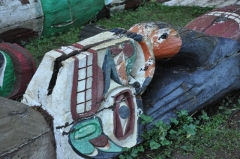
One of the primary type trees there is cedar - both red and yellow. Red cedar was used extensively in carvings and totems - however over time and particularly given the coast rainforest conditions the totems rot.
There are very few carvers anymore and the cost of poles prohibitive so it is more than imperative that these totems are kept and preserved - but what price preservation.
Was out walking through one of the local parks in Nanaimo when I came across these totems that have actually been cut down (rather than let them break off on their own).
The controversy is what to do with them now?
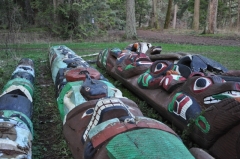
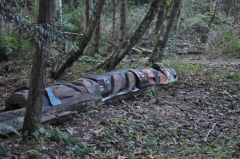
You can see from this angle that the poles are essentially rotted. The discussion is 'who' should be saving these? The First Nations people? The families they represent? The city? Provincial gov't? Federal gov't? (First Nations people come under Federal jurisdicition)
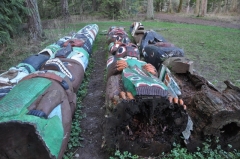
Part of the problem is the size of these totems and trying to move them and where to put them. Even if they are dried out how structurally sound are they?
It is really sad that these totems are disappearing. Alert Bay, which is a small community on a smaller island off the coast of Vancouver Island has a virtual treasure trove of totems but many are falling and since they are no longer being automatically replaced by the First Nations family they are fading into the past. I fear that in a few more generations most of the artistic history of the people - Nootka, Salish, Haida, Tlingit etc will be gone.
Egyptians are lucky in this sense. They are in desert which serves as its own preservative. Rain forst isn't condusive to preserving cedar.
One of the primary type trees there is cedar - both red and yellow. Red cedar was used extensively in carvings and totems - however over time and particularly given the coast rainforest conditions the totems rot.
There are very few carvers anymore and the cost of poles prohibitive so it is more than imperative that these totems are kept and preserved - but what price preservation.
Was out walking through one of the local parks in Nanaimo when I came across these totems that have actually been cut down (rather than let them break off on their own).
The controversy is what to do with them now?
You can see from this angle that the poles are essentially rotted. The discussion is 'who' should be saving these? The First Nations people? The families they represent? The city? Provincial gov't? Federal gov't? (First Nations people come under Federal jurisdicition)
Part of the problem is the size of these totems and trying to move them and where to put them. Even if they are dried out how structurally sound are they?
It is really sad that these totems are disappearing. Alert Bay, which is a small community on a smaller island off the coast of Vancouver Island has a virtual treasure trove of totems but many are falling and since they are no longer being automatically replaced by the First Nations family they are fading into the past. I fear that in a few more generations most of the artistic history of the people - Nootka, Salish, Haida, Tlingit etc will be gone.
Egyptians are lucky in this sense. They are in desert which serves as its own preservative. Rain forst isn't condusive to preserving cedar.
