The WWII airfield at Hawkinge housed a fighter squadron and was also a refueling station for aircraft on long haul missions over Europe. So it was a prime target for the Luftwaffe. For a small village like Hawkinge, the cemetery is vast but incredibly well kept with manicured lawns around the graves and the most impressive line of Yew trees right along the main central avenue. In one corner is located the CWGC cemetery for war dead from WWII. This comprises 95 allied servicemen, mostly RAF but some personnel from other military and non military services including some from the commonwealth.
A short pano of the allied section
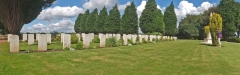
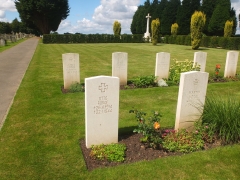
Also laid to rest among the 95 are twelve graves of German servicemen who died on British soil. In a separate small cemetery nearby there are a further 47 German graves and as far as I know all the Germans were airmen killed when their aircraft were shot down. Most have the names engraved but there are a few marked simply ‘Ein Deutscher Soldat’. I found it very poignant that these young men, fighting for their countries, should be laid to rest together.
A corner of the main area with both allied and German graves.
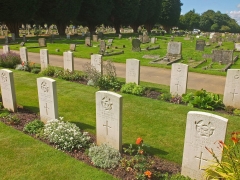
The German area.
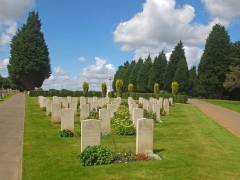
Kurt Sifrar, 20 yoa, the youngest German I found.
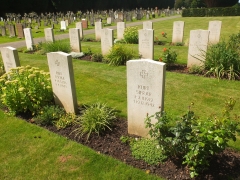
The new headstone of recently identified Otto Runge
I have been asked why their remains of German servicemen were not repatriated to their home countries. I don’t know the answer but could turn the question around and ask why British servicemen buried in foreign countries had not been repatriated. I hope that some of the German families have come to Hawkinge to visit the graves of their family members.
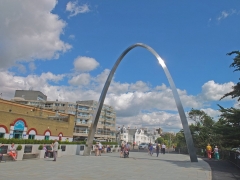
Next port of call was The Leas high up to the west of Folkestone. This was the location on Monday of last week, 4 August, for Prince Harry to officially dedicate a rather splendid memorial called ‘The Step Short Memorial Arch’. Step Short is a Folkestone charity established in 2008 whose objective is to continually remember and highlight the role played by Folkestone and its people as a principle embarkation port for servicemen on their way to France in WWI. The arch is very modern by design and in the evening the inside surface comes alive with hundreds of twinkling LED’s.
The Step Short Memorial Arch.
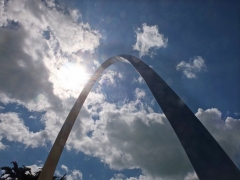
A more dramatic view (but I DID have a job to get up
 )
) 
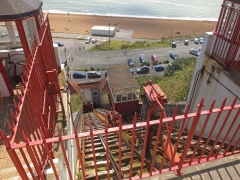
Just a few steps from the arch is ‘The Leas Lift’. This is a Victorian water balanced funicular which opened in 1885. It remains intact, as built, and in daily use. It is estimated that in the 129 years since it opened for business, up to 50 million people have used it. And it saves a hard climb from the beach below.
The water balance funicular filling with water.
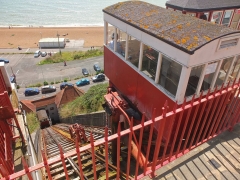
Now heavier than the lower carriage it can pull it up.
Just a few little historical snippets that we came across this morning. We ended up at The Bell in Hythe for some lunchtime refreshment……